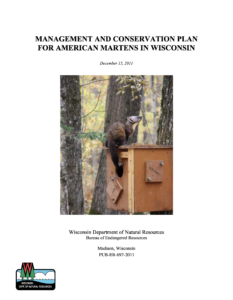

Since the 1970’s Wisconsin’s Department of Natural Resources (WDNR) has been reintroducing American marten in northern Wisconsin, where like Vermont, the small member of the weasel family was extirpated in the 1800’s due to over trapping and habitat destruction. The American marten is Wisconsin’s only endangered species, and recovery efforts are driven by a partnership between WDNR, Tribal governments and the Wisconsin Trappers Association. Three localized regions of the marten’s traditional range have been designated Marten Restoration Areas, where traps known to capture marten “incidentally” are prohibited and trappers are required to use non-lethal trapping methods, or make modifications to traps to minimize the incidental take of the endangered species.
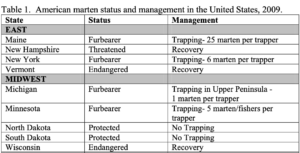
On October 14, 2026 Vermont Wildlife Patrol’s (VWP) state director, Rod Coronado presented a petition to the Vermont Fish & Wildlife Board (VFWB) requesting similar restrictions to Wisconsin’s in Vermont’s own American marten recovery areas. The American marten also has state endangered species status and the 2025 Vermont Wildlife Action Plan ranks marten as a high priority species of greatest conservation need. VWP’s petition was in response to a recent proposal by the Vermont Fish & Wildlife Board to legalize smaller baited body-gripping traps that were prohibited in 2024, when the Vermont Fish & Wildlife Department (VFWD) was directed by Act 159 to modernize trapping regulations to improve animal welfare and reduce the incidental take of domestic pets and non-target wildlife.
At a July 2026 VFWB meeting, Chair Paul Noel stated, “When that rule [furbearer] did get passed, there was an error in the final ruling that we all missed. You can call it a typo, a clerical error, an administrative error. I’ll get into it in more detail another time, but it involves the use of baited body grip on land. There was an error in the size of trap that could be used in that scenario. So I’m going to get this on the agenda for next month and know we can get into it more deeply then, but it’s going to involve opening up the trapping rules to fix this error. It’s been a hardship for trappers for the last two years.”
The baited body-gripping traps Noel refers to are those preferred by trappers targeting fisher. Since 2004, there have been at least 46 reports of endangered marten being caught during Vermont’s fisher trapping season. And while the VFWD says an average only 2.5 marten are caught in fisher traps annually, in some years such as 2012, as many as 11 marten were killed in legal traps set for fisher. Unlike Wisconsin, where the Wisconsin Trappers Association supports restrictions on trapping in the state’s Marten Restoration Areas, the Vermont Trappers Association supports the legalization of the most common smaller sized body-gripping traps responsible for over 20 years of incidental take in predominantly three small areas of Vermont.
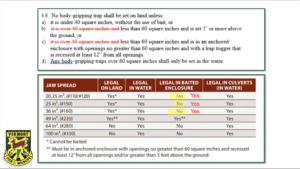
When asked to clarify the reason for wanting to again legalize smaller baited body-gripping traps in Vermont, the VFWD’s general counsel, Hannah Smith stated in a letter, “The proposed change is a technical correction of an unintentional limitation on trap size, the correction is intended to reduce instances of incidental take.” But Vermont is not the only state where incidental take of endangered marten by trappers occurs. According to Wisconsin’s Management and Conservation Plan for American Marten, “Body-grip traps set for fishers appear to be the most common method that leads to incidental take of martens in Wisconsin. For this reason, WDNR and Ojibwe tribes continue to limit trapping opportunities in the MPAs.” The plan further identifies education and training priorities stating, “Trapper education courses should at a minimum discuss marten ecology, current regulations, MPA locations, and alternative trapping techniques to reduce incidental mortalities.”
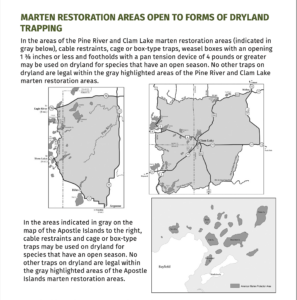
2026-27 Wisconsin Trapping Regulations (see page 24)
https://widnr.widen.net/s/sgrgkgsjqm/fall-2026-spring-2027-wisconsin-trapping-regulations_pdf
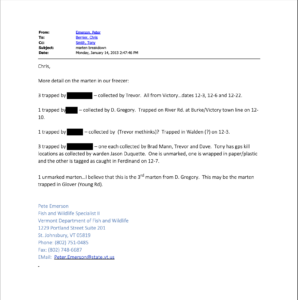
Yet, currently the Vermont Fish and Wildlife Board’s Chairman (himself a trapper), Vermont Fish & Wildlife Department and Vermont Trappers Association all support a return to the use of traps most responsible for killing endangered marten in Vermont, despite the incidental takes occurrence in very localized areas where trappers are only required to report marten captures to a warden. According to warden reports obtained through a public records request by VWP, in 2016 one individual fisher trapper caught four marten in just five days of the month-long fisher trapping season in Vermont. He was allowed to continue trapping without any restrictions. In 2012, two fisher trappers were responsible for catching and killing three endangered marten each with three additional marten also killed during the 2012 fisher trapping season.
In a December 28, 2023 Vermont Fish & Wildlife Department press release announcing trapping rule changes as a result of Act 159, the VFWD stated, “The new regulations include a requirement that live trapped animals be killed humanely and establish standards for trap types and use of baits to reduce the risk of catching pets and non-target wildlife.” The then Commissioner of VFWD, Christopher Herrick added, “Vermont’s new trapping regulations will make trapping safer and more humane. They strike a middle ground between concerns raised by both activists and trappers, and are among the most comprehensive trapping regulations in the country.” Yet, by July 2026 absent any biological justification and citing only a hardship caused to trappers, VFWD is recommending again legalizing the very traps most responsible for the incidental take of endangered marten in Vermont. https://www.vtfishandwildlife.com/press-releases/new-regulations-trapping-come-effect-january-1-2024

It’s time for the Vermont Fish & Wildlife Department, Board and Vermont Trappers Association to follow the lead demonstrated in Wisconsin and restrict the use of baited body-gripping traps in Vermont’s marten recovery areas rather than return them to the landscape where they have already killed dozens of endangered marten. Towards that goal, Vermont Wildlife Patrol is asking Vermonters to contact their county representative of the Fish & Wildlife Board requesting that they vote in support of establishing marten caution areas and the restrictions on the use of baited body-gripping in those recovery areas with a history of incidental take of marten. The successful recovery of the American marten is possible, but not without responsible science based decisions by our Fish & Wildlife Board and Department.
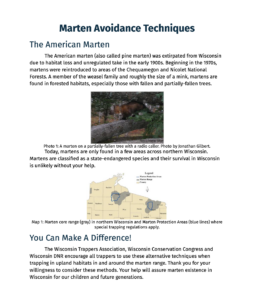
Click link to see full PDF: https://widnr.widen.net/s/wtbfsnkwwp