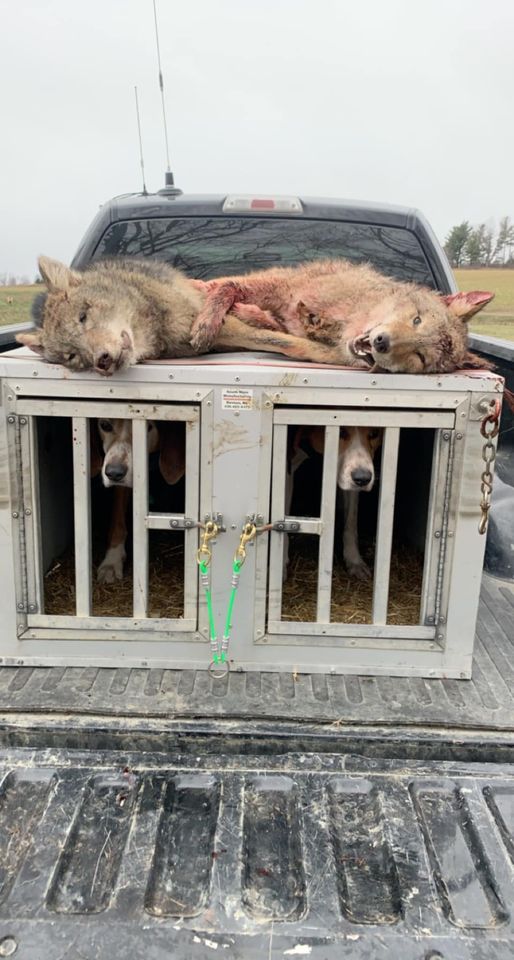
Vermont Wildlife Patrol’s December 2023 investigation of fisher trapping practices.
Vermont’s Act 165 required the state’s Fish & Wildlife Department to introduce Best Management Practices (BMPs) for trapping, which are industry standards based on decades of trap research funded by the fur industry. BMP’s for trapping were first introduced in 1991 in response to the European Union’s ban on the importation of furs taken with inhumane trapping methods such as non-lethal foot-hold traps. The most common traps used to take wildlife in Vermont are non-lethal foot-hold and lethal body-gripping traps. While a foot-hold trap is meant to restrain a wild animal, body-gripping traps are designed to crush a target animal’s vital areas with rotating steel jaws.
In June 2023, Vermont Wildlife Patrol began asking Vermont Fish & Wildlife questions about the Conibear 220 body-gripping trap, and published BMP research which concluded that it was ineffective at killing fishers humanely in trap experiments conducted in Canada in 1989. BMP standards for body-gripping traps require that at least 70% of live fisher test subjects be killed within 300 seconds of being caught in a body-gripping trap. In the published tests, researchers stated, “The mechanically improved rotating-jaw traps used in this study were much more powerful than the standard model yet, they did not consistently render fisher irreversibly unconscious within five minutes. Therefore this rotating jaw traps cannot be expected, at a 95% level of confidence to render 70% of fishers captured on traplines irreversibly unconscious in three minutes.”
At a June 2023 meeting with Vermont Wildlife Patrol in regards to the Conibear 220, VFW Wildlife Management Program Director, David Sausville and Furbearer Project Leader, Brehan Furhey were asked, “Act 159 directed VFW to reduce the level of suffering animals experience in traps, yet there are no recommended changes to the use of or size of body-gripping traps used to kill fisher despite some legal fisher traps having been proven to not be effective at killing fisher. Why has the department not made any recommended changes to the use of body-gripping traps themselves that do not adhere to BMP standards?” Both Department officials were unable to provide any answers despite having been provided with questions in advance of the meeting. Finally in December 2023, Sausville responded to the still unanswered questions stating, “The (research) paper (cited) is outdated, the traps are no longer sold, that brand had larger dimensions than typical 220 body gripping traps of today, and the traps of 1988/1989 would be illegal if set on land today. Body gripping traps in the 220 range are indeed BMP approved for trapping fisher and are produced under a variety of commercial names.”
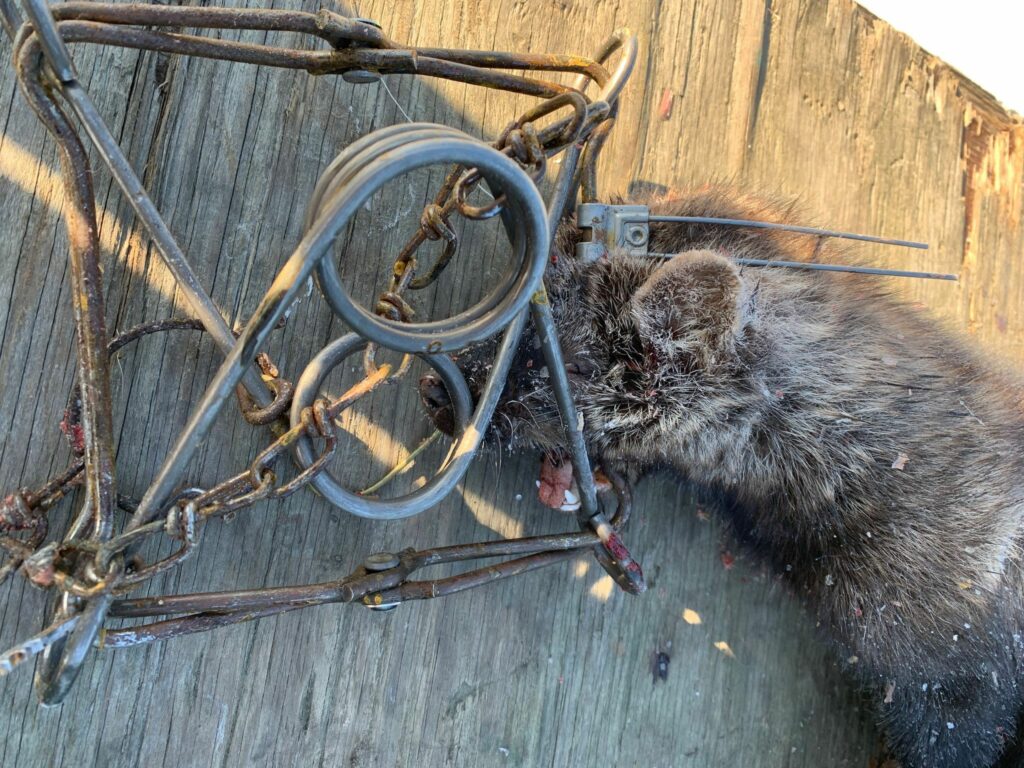
Fisher trap in the Silvio O. Conte National Wildlife Refuge, December 2023.
When again asked for published research which supported that claim in October 2023, Vermont Fish & Wildlife said the department had no published BMP research on body-gripping traps because those experiments were carried out in Canada by the Fur Institute of Canada, which has refused to provide any published BMP research on body-gripping traps to the public. In an email response for any such records, the Commissioner of VFW’s principal assistant stated, “We do not have records of the research that was conducted by the Canadian Provincial authorities, the Fur Institute of Canada, and AFWA for testing body-gripping traps to develop the BMPs.” Yet in the June 2023 Responsiveness Summary: Public Comments Best Management Practices for Furbearer Trapping, Vermont Fish & Wildlife stated, “The BMPs to improve the welfare of trapped animals are backed by a 23-year international science-based research effort by AFWA (Association of Fish & Wildlife Agencies) as well as input from our stakeholder working group. Trapping systems that do not meet these criteria will become illegal.”
A skinned mink carcass used for bait in a Vermont fisher trap on the Silvio O. Conte National Wildlife Refuge in December 2023.
Vermont Wildlife Patrol and many citizens remain unconvinced about the killing efficiency of body-gripping traps according the VFW’s summary of public comments received about the new trapping rules. For example, in January 2022 a fisher was found on the VAST snowmobile trail in Troy, Vermont with a body-gripping trap on its head. The animal was able to be picked up and driven on a snowmobile to a location where the warden could be called, but without signal, the woman decided to humanely dispatch the fisher with her handgun. According to the investigating warden, “The trap had caused severe damage to the face and mouth areas of the fisher. The fisher would not have been able to open its mouth at all and was most likely blind. As a result of my observations, my estimate was that the fisher had been caught by the trap only a few days prior at most.” The same trapper who is also contracted with the Department of Transportation (VTrans) as a nuisance trapper, was cited for catching the fisher out of season, but the incident highlights the questionable killing power of body-gripping traps currently used to kill fisher in Vermont.
The fisher found in Troy, Vermont stumbling on the VAST snowmobile trail with a Duke 160 body-gripping trap on her face.
Vermont’s fisher trapping season runs the entire month of December and according to trapper surveys for the last ten years, on average between 150-300 fishers are killed each season, most often using traps similar to the 160 body-gripping trap reportedly found on the fisher in Troy. The 160 is much smaller than the 220 trap which failed the reported BMP tests. This year, Vermont Wildlife Patrol began an investigation of fisher trapping practices in the Northeast Kingdom to determine whether animals caught in body-gripping traps were indeed being humanely killed. We remain unconvinced that traps currently listed as BMP approved are effective at killing fishers within the BMP required five minutes in lab tests. Until Vermont Fish & Wildlife provides scientific evidence that the 160 & 220 body-gripping traps used to legally take fisher in Vermont have passed BMP tests, we are asking that the traps be made illegal as was earlier promised by the Vermont Fish & Wildlife Department.
Link to Vermont Fish & Wildlife’s timeline of rule making process for trapping BMP’s:
On December 14th, 2023, in its sixth hearing on Vermont’s proposed new trapping and coyote hounding rules, the Legislative Committee on Administrative Rules (LCAR) voted to certify four objections to major portions of the state’s new trapping and coyote hunting with hounds laws. Both the Vermont Fish & Wildlife Department (VFW) and Fish & Wildlife Board have expressed that LCAR’s objection to the use of GPS shock and tone collars as a control method for coyote hunting hounds equates to a “de facto ban” on the practice. Recognizing that there is no effective means to recall loose hunting hounds when they either trespass or attack pets and livestock, LCAR recommended amending the proposed rules to include keeping hounds in visual sight and under voice commands, which board members stated was “impossible.” According to the VFW’s new Hunting Coyotes with the Aid of Dogs web page the new rules state that, “…at all times during training dogs and taking of coyote with the aid of dogs the permittee shall be able to locate and remotely recall the dogs.”
Vermont Legislative Committee on Administrative Rules December 14, 2023 letter to Vermont Fish & Wildlife Department
The certification of the objection with the Secretary of State was accompanied with a letter to the Fish & Wildlife Department explaining why LCAR members believed the moratorium on coyote hunting with hounds remains in effect because the Department’s definition of control did not meet the minimum legislative intent of Act 165. From the 12/14/23 letter:
“The five members of LCAR who voted to file the fourth objection in certified form are of the opinion that the fourth objection being filed in certified form shifts the burden of proof to the Fish and Wildlife Board in any action for judicial review or for enforcement of the rule related to Secs. 3.6 and 4.20, see 3 V.S.A. § 842(c)(2), and should be interpreted as evidence that the current moratorium on pursuing coyote with the aid of dogs is not lifted upon the effective date of the November 30, 2023, Rule, if adopted, because Secs. 3.6 and 4.20 of the November 30, 2023, Rule do not meet the minimum requirements of the rules required by Sec. 3 of Act 165, specifically Sec. 3(b)(4), and therefore the triggering event for the repeal of the moratorium in Act 165, Sec. 2(b) has not been met.“
Curiously, on the Hunting Coyotes with the aid of Dogs web page, VFW chose only to provide a public link to LCAR’s letter to the Secretary of State, not its letter to VFW which included the above language regarding the moratorium.
Three other objections were certified with the Secretary of State related to a proposal to redefine trapping as a form of hunting, the definition of public trails and a proposed exemption from setback requirements for traps that are placed in the water. The redefinition of trapping as a form of hunting would have provided greater constitutional protections for the controversial practice. Vermont’s Constitution includes provisions on hunting, fishing and fowling, but not trapping. Vermont Fish & Wildlife Department legal counsel, Catherine Gjessing testified that the change was simply “housekeeping” and when asked by the Chair of LCAR whether the legislative mandate of Act 159 directed the Department to enact such a change, her response was “no.” (see video below)
Vermont Fish & Wildlife legal counsel, Catherine Gjessing answering LCAR Chair, Trevor Squirrell’s questions about objections.
In response to LCAR’s objections, the Vermont Fish & Wildlife Board held a special meeting on December 14, 2023 where board members voted unanimously to advance the new rules despite the four objections from LCAR. When board member, Paul Noel asked the Commissioner of Vermont Fish & Wildlife, “I want clarification on what would happen with the coyote hounding moratorium if we do vote to advance these rules tonight…” Commissioner Christopher Herrick responded, We are looking at our legal options right now.”
On December 18, the Vermont Fish & Wildlife Department’s website was updated to include a page where applicants could begin the process to obtain a coyote dog permit with a application deadline of January 15, 2024. When Vermont Wildlife Patrol asked Commissioner Herrick about the moratorium, he responded, “In accordance with Vermont law, the Fish and Wildlife Board has the authority to adopt the Furbearing Species Rules after responding to the LCAR objections. The adopted rules have been filed and will become effective January 1, 2023. As such, the moratorium is automatically repealed on that date.”
LCAR’s objections pave the way for legal challenges to the new rules with the burden of proof resting on the Fish & Wildlife Department. Due to the objection to the definition of “control” in regards to coyote hounds, if challenged in court, the Department will have to convince a judge that GPS shock and tone collars do indeed equate to control and thus meet the legislative mandate of Act 165.
Vermont Wildlife Patrol will resume its citizen monitoring of coyote hunting with hounds across the state in January 2024, if indeed the moratorium on coyote hunting with hounds is lifted. The intent of our monitoring effort will be to ascertain whether hound hunters are in accordance with new regulations, specifically the ability to remotely recall loose hounds. We will also be gathering evidence to provide to legislators to illustrate what hunting coyotes with dogs in Vermont really looks like.
Photo shared on Facebook by Wallingford, Vermont hound hunter, Terance Wilbur.
This is a condensed video of the November 16, 2023 Legislative Committee on Administrative Rules hearing where lawmakers voted to object to four key provisions of VFW’s proposed trapping and coyote hounding rules.
On November 16, 2023 Vermont’s Legislative Committee on Administrative Rules (LCAR) voted to approve the Vermont Fish & Wildlife Department’s (VFW) proposed trapping and coyote hunting with hounds rules, but with four key objections that could lead to legal challenges in the future on the grounds that the rules did not meet the legislative intent of both Acts 159 and 165.
Both laws directed the Commissioner of Fish & Wildlife to propose new regulations for hunting coyotes with hounds and trapping rules to reduce the instances of domestic pet captures and the level of suffering experienced by animals in traps. In hearings that began in October, LCAR has shared the concerns of wildlife advocates that the rules favor trappers and hounders more than the interests of public safety and wildlife. At the October 19, 2023 LCAR hearing on the subject, Vermont Wildlife Patrol was one of the numerous groups testifying as to why the proposed rules failed legislative intent, such as body-gripping traps that have not passed Best Management Practices (BMP) tests or the exemption of traps in the water from new rules that would require traps be set at least 50 feet from public roads and trails.
In October 2023, a cat was caught in this trap in Williston, Vermont.
On November 16, VFW Legal Counsel Catherine Gjessing weakly explained why the Department believed its proposed rules met legislative intent, including her description of over two dozen witnesses who testified against the rules in October as being “sophisticated animal rights advocates…who represent a minority of Vermont.” Yet, the 2022 Responsive Management survey that VFW often cites as an indicator of Vermonter opinions on trapping recorded 68% of respondents being opposed to recreational trapping. Later during the hearing, Senator Christopher Bray explained why he was introducing a motion to approve the rules but with objections saying that as Chair of the Committee on Natural Resources and Energy, he believed the proposed rules did not fully meet the legislative intent of both Act 159 and 165. He then introduced a motion to object to VFW’s exemption of traps in the water or under ice from the new required setback from public trails of fifty feet on the grounds that the legislature did not instruct the Commissioner to make such an exemption. In Vermont, the majority of all trapping takes place in the water and under the ice, often immediately off of trails and roads where beavers are active.
Like other fighting dogs, coyote hounds are taught and praised for their bloodlust.
Next, Senator Bray introduced a second motion to object to the definition of control of dogs which VFW’s proposed rules say are GPS collars that monitor the movements of loose hounds without maintaining visual contact. In a memo to VFW dated October 26, four LCAR members stated, “While we can see value in using a training/control collar as that term is proposed to be defined, we would like to see proposed modifications to Furbearing Species Rule, Sec. 4.20 that actually effectuate the General Assembly’s intent as expressed in Act 165, possibly through requirements around maintaining dogs that are being used to aid in the taking of coyote in visual site or under voice control, or both.”
Later, Rep. Mark Higley would say that such an objection could amount to a defacto ban on hunting coyotes with hounds. Representative Seth Bongartz then made a motion to object to VFW’s proposed new definition of trapping, which would increase the likelihood that it might become a protected activity under the Vermont Constitution which does protect hunting. Rep. Bongartz then introduced a second motion to object to VFW’s proposed definition of public trails which VFW has worked tirelessly to exclude trails used by trappers such as the VAST trail network.
Over 350 coyotes were trapped and reported in Vermont’s mandatory trapper survey during the 2020-21 season. Unfortunately, on average 30% of licensed Vermont trappers fail to return the surveysaccording to VFW’s own records.
The Vermont Fish & Wildlife Department and Board must now respond to LCAR’s objections by November 30, 2023. If the failure to meet legislative intent is not addressed to the satisfaction of LCAR, the rules will move forward but be subject to legal challenges by a host of affected individuals and organizations. To view testimony submitted on behalf of Vermont’s wildlife by advocates, please visit:
Vermont Wildlife Patrol’s October 2023 testimony to the Legislative Committee on Administrative Rules.
For months, Vermont Wildlife Patrol and many other wildlife advocates have testified to the shortcomings of the Vermont Fish & Wildlife Department & Board’s proposed changes to trapping and coyote hunting rules. On October 5, 2023 the Vermont Legislative Committee on Administrative Rules (LCAR) met to review the proposed changes to determine if they met the legislative intent of both law’s, Act 159 and Act 165. Act 159 mandated that the department propose changes to trapping to reduce the level of suffering experienced by animals in traps, and to reduce the risk of capture of domestic pets. Act 165 establishes rules and regulations for the hunting of coyotes with hounds, a previously unregulated sport in Vermont and most states in the country.
The October 5th hearing was an opportunity for Vermont Fish & Wildlife officials to explain to LCAR their reasoning behind their weak proposed changes, which heavily favored trappers and hound hunters by excluding many forms of trapping and hounding from any changes. A second hearing on October 19th, gave wildlife advocates including members of Vermont Wildlife Patrol, Animal Wellness Action, Green Mountain Animal Defenders, Protect Our Wildlife, Vermont Wildlife Coalition, Project Coyote, In Defense of Animals and other citizens the opportunity to respond. One of the citizen’s testifying was Katy Cupo, from Castleton who’s German shepherd was caught in a legally set body-gripping trap on October 3rd. The trap was set for beaver the day before by a nuisance trapper recommended by the Vermont Fish & Wildlife Department to Castleton University which owns the land the trap was set on.
The October 19th LCAR hearing. Public testimony begins at 9:15.
Public testimony from Vermont Wildlife Patrol focused on two major shortfalls of the proposed trapping changes, the failure of the department to provide any scientific evidence that the 220 body-gripping trap currently used to kill fisher in Vermont, had passed BMP testing as required by Act 159 and secondly, the exclusion of traps placed in the water from any recommended trail and road setback rule. Already at the October 5th LCAR hearing, committee members expressed many concerns that the department’s proposal did not include all trails in Vermont, instead only those mapped by the Department of Transportation.
We provided video testimony to LCAR from an active Department of Transportation nuisance beaver trapping site in West Pawlet on the D&H Rail Trail, where body-gripping and foot-hold traps were placed less than twenty feet from trails used by dog walkers. Our testimony illustrated how traps that were placed in the water would continue to pose dangers to domestic pets under the current recommended changes that exclude all traps placed in the water. In Vermont, the majority of trapping is done for beaver and muskrat, both aquatic species, yet Vermont Fish & Wildlife excluded water trapping from any proposed impact of Act 159.
On October 27, 2023 LCAR members briefed the Vermont Fish & Wildlife Department on why they believed the current proposed changes did not meet legislative intent in a memo that explained the four major areas the committee felt were in contradiction to legislative intent. The first was to not include all Vermont trails from trap setback rules and the second was the failure to include traps in the water from the reach of Act 159.
“In the water” beaver traps intended to drown animals after capture at West Pawlet, Vermont September 30, 2023
“We are also of the opinion that it is inconsistent with the intent of the General Assembly and arbitrary to exempt traps that are in the water or under ice from setback requirements. There was no reference to any such exemption in Act 159, nor do we think that it makes sense to a reasonable person that individuals, potentially with their domesticated animals, would not be recreating in water or on ice that is within 50 feet of the edge of the traveled portion of a legal trail, public trail, or public highway. We would like to see this exemption eliminated from Furbearing Species Rule, Sec. 4.15.”
Legislative Committee on Administrative Rules October 27, 2023
The October 27, 2023 LCAR memo to Fish & Wildlife.
The other issues taken by LCAR were with the recommended method of control of loose hounds by coyote hunters to still only be by GPS radio shock, tone and tracking collars. Under the recommended changes, there were no meaningful changes made to the practice of hunting coyotes with hounds, only rules governing the existing practices like using GPS collars to track hounds as they sometimes roam miles of terrain. Committee members suggest hounds be within eyesight and controlled by voice commands.
The last substantiative disagreement made was to address what was clearly an attempt by the department to place trapping under the protection of Vermont’s Constitution which currently protects only “hunting, fowling and fishing.” Within the proposed changes, the Vermont Fish & Wildlife Board had also voted to change the definition of trapping in Vermont to a means of hunting, not a separate practice. LCAR cited no legislative intent for such a change, and requested that the change be omitted.
Next comes the November 1st, 2023 Vermont Fish & Wildlife Board meeting, where members of the board must vote to approve any recommended changes to the current and previously voted on proposal which has now been rejected by LCAR. The Vermont Fish & Wildlife Board could vote to move the current proposal forward without LCAR’s support and the rules could be promulgated without LCAR’s recommended changes, but such a path would leave the Board open to what would be a certain court challenge by wildlife advocates including Vermont Wildlife Patrol.
Hear Vermont Fish & Wildlife legal counsel, Catherine Gjessing explaining what the department did not want the public to hear.
On November 2, 2023 LCAR will reconvene to possibly review and vote on any new proposed changes from the Fish & Wildlife Department and Board, which must be received by Noon, October 30, 2023. All relevant documents including Vermont Wildlife Patrol’s testimony and supporting evidence is available from the LCAR website. The October 5th hearing schedule includes mostly written testimony, whereas the October 19th hearing included mostly verbal testimony from 40 witnesses.
Join Vermont Wildlife Patrol as we continue to fight for our animal relations! Come to the November, 1st Vermont Fish & Wildlife Board meeting:
The Vermont Fish and Wildlife Board will hold a virtual meeting at 5:00 pm. November 1, 2023 Most Board Members and department staff will be attending remotely. There is an in-person option for members of the public who cannot attend virtually, at the Davis Building, 1 National Life Drive, Montpelier, VT 05620.
Click below for meeting agenda and link to watch remotely!
Last year, over a dozen dogs and cats were caught in foot-hold and body-gripping traps in Vermont. At least two dogs and one cat died. Vermont’s Legislative Committee on Administrative Rules (LCAR) is currently reviewing proposed changes to trapping rules that are intended to reduce the danger posed to pets by traps placed near roads and trails, which is a common trapping practice in Vermont.
Just this October 3, 2023 a woman was walking her German shepherd on the Castleton University trail system when the dog was caught in a body-gripping trap set only seven feet from the trail by a licensed nuisance beaver trapper. Vermont Wildlife Patrol is asking dog owners to exercise caution in areas where traps might occur, especially in areas near water with beaver activity. Cat owners should also not leave animals out overnight where they might roam and encounter a recently set trap. There have been two reports this October alone of cats being caught in nuisance animal traps set for skunk and other wildlife, one in Barre and the latest in Williston on October 24th.
How to release your pet from a body-gripping trap:
LCAR’s next hearing is November 2, 2023. For information from the October 5th & 19th sessions: https://legislature.vermont.gov/committee/detail/2024/39
Read the latest memorandum from LCAR to the Vermont Fish & Wildlife Department and Board about the need to make the public safer from the consequences of legal trapping and the hunting of coyotes with hounds in Vermont.
On October 3, 2023 a woman was walking with her dog on a path regularly used by students and staff on the Castleton University campus when her German shepherd, Gus stepped into a body-gripping trap set for “nuisance” beavers just seven feet off a university trail. The trap had been set a day before by a trapper referred to the University by a Vermont Fish & Wildlife warden. The University was responding to long-term problems with a manmade dam on a pond surrounded by public trails. At least three beavers had already been trapped using similar body-gripping “kill” traps which are known to take up to five minutes to kill beavers and other aquatic animals. Traps for beaver are commonly set immediately off of roads and culverts where beavers are active and near beaver dams. The trap that caught the 100-pound pet was a 330 body-grip trap that was set on the pond’s edge in inches of water. The trap caught the dog on the front leg and fractured two bones and caused other serious, but not life threatening injuries.
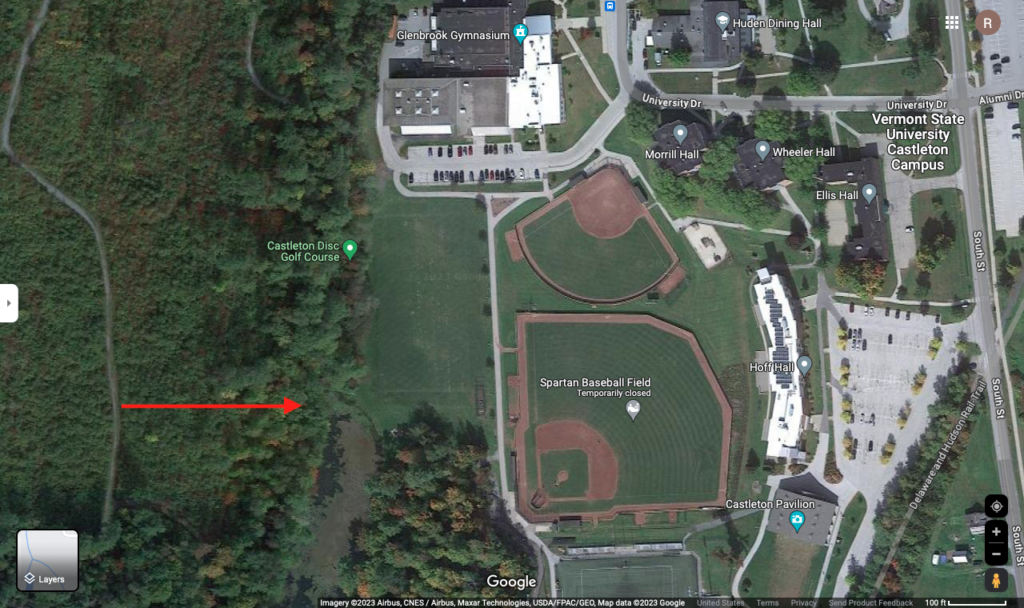
Red arrow denotes location of trap that caught Gus.
Recent nuisance trapping for beavers in Castleton and West Pawlet has seen deadly body-gripping traps being set just feet off of trails regularly used by dog walkers. These “drowning sets” are intended to catch beavers who are either crushed in the body-grip trap, or drown when the trap drags them underwater. The Vermont Fish & Wildlife Department (VFW) is recommending changes to current trapping practices, as directed by the Legislature in Act 159 which seeks to reduce the incidents of domestic pet captures and reduce the level of suffering experienced by wildlife caught in Vermont traps. The Green Mountain state boasts a population of approximately 300 active recreational trappers. Last year, fifteen pets were accidentally caught in traps, the three that died were caught in body-gripping traps. There are no recommended changes from VFW in the placement of traps in the water and the current recommended setback of 100 feet from public trails would not apply to both nuisance trappers or trappers who place traps in the water, which is the most common form of trapping in Vermont, usually for beaver and muskrat.
The 330 body-grip trap that caught Gus in Castleton, Vermont.
Vermont’s Legislative Committee on Administrative Rules (LCAR) is currently reviewing VFW’s recommended changes to trapping and coyote hound hunting rules, having held a public hearing on October 5th, just two days after the Castleton trapping incident. At the hearing, VFW Legal Counsel, Catherine Gjessing testified about the “low-risk” trapping poses to people and pets in Vermont, incorrectly citing that one of the dogs killed in a body-gripping trap in 2022, was caught in an illegal trap. Vermont Wildlife Patrol provided LCAR with the VFW warden’s report for the trapping incident in Underhill last October, where a woman’s dog was killed in a legally set body-gripping trap.
The next LCAR hearing on trapping and coyote hound hunting rules will be on November 2, 2023. The following is the recorded hearing from the October 5 & 19, 2023 LCAR session where Vermont Fish & Wildlife legal counsel defended the recommended changes and Vermont Wildlife Patrol testified about the failed “Best Management Practices” testing of the 220 body-gripping trap and its inability to kill fishers in the required five minute threshold for BMP kill traps.
Testimony of Castleton resident whose dog, Gus was captured in a body-gripping trap on October 4, 2023.
Vermont Wolf Patrol was one of the eight wildlife advocacy groups on October 5, 2023, listening to the Vermont Fish & Wildlife Department’s presentation to the Legislative Committee on Administrative Rules (LCAR) on proposed changes to trapping rules, when unbeknownst to committee members, the day before, another dog had fallen victim to a body-gripping trap in Vermont. The Department’s legal counsel, Catherine Gjessing spoke to the minimal risk posed to pets and humans by Vermont’s estimated 300 licensed trappers at LCAR’s hearing to review proposed changes, which fell far short of the legislative mandate of Act 159 which states:
This act requires the Commissioner of Fish and Wildlife to submit to the General Assembly recommended best management practices (BMPs) for trapping that propose criteria and equipment designed to modernize trapping and improve the welfare of animals subject to trapping programs. The BMPs shall be based on investigation and research conducted by the Department of Fish and Wildlife and shall use the “Best Management Practices for Trapping in the United States” issued by the Association of Fish and Wildlife Agencies as the minimum standards for BMP development. After submission of the BMPs, the act requires the Fish and Wildlife Board to revise the rules regulating the trapping of furbearing animals in the State so that the rules are at least as stringent as the BMPs for trapping recommended by the Commissioner of Fish and Wildlife.
A large complaint of LCAR committee members was the failure to include setbacks for trappers on public trails on Vermont’s 100 Wildlife Management Areas, parks and even playgrounds and other places where people are expected to recreate. Department staff responded to the complaints with a proposal to return to LCAR on October 19, 2023 after the Department has had a chance to make improvements to the proposed minimal setbacks and take them to the Vermont Fish & Wildlife Board for approval and a vote on October 18, 2023.
Watch Vermont legislatures question the Fish & Wildlife Department’s failure to meet the legislative mandate of Act 159.
Meanwhile, On October 3, 2023 a woman was walking with her dog on a path regularly used by students and staff on the Castleton University campus when her German shepherd, Gus ran towards the edge of a pond on campus where they normally played. Only this time, the dog began howling and the owner realized they had been caught in something metal. Over 200 yards away, university employees at a baseball field heard the dogs cries and came running to help. After more than twenty minutes, three people were able to remove the body-gripping trap from the dogs front leg which suffered a fracture and other injuries that required veterinary attention. This body-gripping trap set for “nuisance” beavers was just seven feet off a university trail.
Red arrow denotes trap location.
The trap had been set a day before by a trapper referred to the University by a Vermont Fish & Wildlife warden. The University was responding to long-term problems with a manmade dam on a pond surrounded by public trails. At least three beavers had already been trapped using similar body-gripping “kill” traps which are known to take up to five minutes to kill beavers and other aquatic animals. Traps for beaver are commonly set immediately off of roads and culverts where beavers are active and near beaver dams. The trap that caught the 100-pound pet was a 330 body-grip trap that was set on the pond’s edge in inches of water.
The 330 body-grip trap is commonly used in Vermont to catch beaver. This one caught Gus.
Vermont Wolf Patrol and Animal Wellness Action’s Bob Galvin drove to Castleton, Vermont on October 6th to meet with Gus’ owner and hear firsthand what had happened. According to the local resident, beavers have complicated existing problems with a manmade dam on the college campus and it was recommended that a nuisance trapper be brought in to trap the animals. It isn’t yet known when exactly the trapping began, but by the end of the day on October 5th, all the traps had been removed and Vermont Fish & Wildlife wardens were investigating the incident.
The warden’s report on the Castleton incident.
Recent nuisance trapping for beavers in Castleton and West Pawlet has seen deadly body-gripping traps being set just feet off of trails regularly used by dog walkers. These “drowning sets” are intended to catch beavers who are either crushed in the body-grip trap, or drown when the trap drags them underwater. The Vermont Fish & Wildlife Department (VFW) is recommending changes to current trapping practices, as directed by the Legislature in Act 159 which seeks to reduce the incidents of domestic pet captures and reduce the level of suffering experienced by wildlife caught in Vermont traps. The Green Mountain state boasts a population of approximately 300 active recreational trappers. Last year, fifteen pets were accidentally caught in traps, the three that died were caught in body-gripping traps. There are no recommended changes from VFW in the placement of traps in the water and the current recommended setback of 100 feet from public trails would not apply to both nuisance trappers or trappers who place traps in the water, which is the most common form of trapping in Vermont, usually for beaver and muskrat.
In December 2022, this small dog was killed in a body-gripping trap while walking with her owner in Corinth.
It was just one week ago on September 30, 2023, when Vermont Wolf Patrol was less than an hour away in West Pawlet, where Vtrans trappers had placed five traps including three body-gripping traps less than fifty feet off the D&H Rail Trail which is also regularly used by dog walkers. This latest incident illustrates the very real danger body-gripping traps continue to pose to pets in Vermont, especially those placed in the water which are currently exempt from any Act 159 improvements, despite many public comments asking for them to be included in any changes to trapping practices. Instead, there are limited restrictions being placed on some body-gripping traps placed on land, but no proposed changes to the practice of placing traps immediately off of roads and trails in the water. Again, the beaver trap in Castleton was just seven feet off the trail.
Testimonies begin at 9:45
Vermont’s Legislative Committee on Administrative Rules (LCAR) is continuing to review VFW’s recommended changes to trapping and coyote hound hunting rules, having held a public hearing on October 5th, just two days after the Castleton trapping incident. At the hearing, VFW Legal Counsel, Catherine Gjessing testified about the “low-risk” trapping poses to people and pets in Vermont, incorrectly citing that one of the dogs killed in a body-gripping trap in 2022, was caught in an illegal trap. Vermont Wildlife Patrol provided LCAR with the VFW warden’s report for the trapping incident in Underhill last October, where a woman’s dog was killed in a legally set body-gripping trap. At the October 19th LCAR hearing, Gjessing again presented on the trapping and hounding proposals and the committee received testimony from 39 individuals including two of the women who’s dog’s have now been caught recently in body-gripping traps.
The next LCAR hearing on trapping and coyote hound hunting rules will be on November 2, 2023. The following is the recorded hearing from the October 5 & 19, 2023 LCAR session where Vermont Fish & Wildlife legal counsel defended the recommended changes and Vermont Wildlife Patrol testified about the failed “Best Management Practices” testing of the 220 body-gripping trap and its inability to kill fishers in the required five minute threshold for BMP kill traps.
Gus, a lucky survivor of a lethal body-gripping trap most commonly set for beaver in Vermont.
Concerned Vermonters should contact their representatives and let them know that Act 159 does not go far enough to limit the dangers posed to pets and people by some of the most common trapping practices in Vermont. According to Vermont Fish & Wildlife law enforcement, beaver and muskrat trapping, in the water, is the most common form of trapping in the state, often occurring in culverts just feet off roads and trails.
Vermont’s Department of Transportation (VTrans) continues to use deadly force to address conflicts with beavers on the D&H Rail Trail outside West Pawlet, despite citizen efforts to convince the public agency to install a non-lethal alternative such as a beaver deceiver or pond leveler. On September 30, 2023 Vermont Wildlife Patrol came to document dog walkers using the trail, just 20 feet from the traps and record testimony on the failure of the Vermont Fish & Wildlife Department to propose adequate reductions in the level of suffering experience by animals trapped in Vermont.
We believe the exclusion of body-gripping traps and drowning sets in any recommended trapping changes currently before the Legislature fails the legal mandate of Act 159. At the West Pawlet trap site, five traps could easily be seen strewn across the small beaver pond which runs under the D&H Trail. Three body-gripping traps were set in the water and two foothold traps could plainly be seen on the bank of the pond, easily within reach of the the many dogs using the trail. Vermont Wildlife Patrol spoke to three separate groups of dog walkers who regularly use the trail and all were unaware of the nearby vicinity of the killing and restraining traps. No signage is used by VTrans when trapping immediately off of roads and trails.
Your Tax Dollars At Work…VTrans Costs from trapping and dam removal in West Pawlet (less than one year)
We are asking concerned Vermonters to contact VTrans Secretary, Joe Flynn and request that lethal beaver removal cease on the D&H Trail, and that agency funds be responsibly spent on long-term non-lethal alternatives, rather that wasting taxpayer dollars on dam removal and trapping
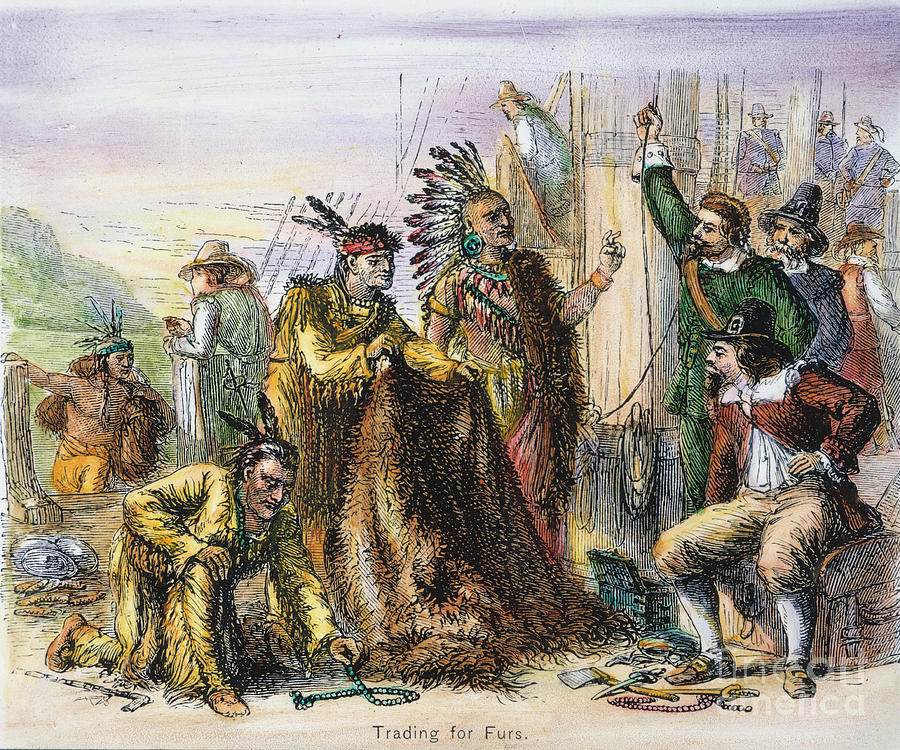
17th Century Dutch fur traders bartering with indigenous Americans for now extinct eastern buffalo hides.
I moved to Vermont in 2019 and live on land that is home to moose, bear, coyote, bobcat and until recently, beaver. I am a caretaker of these wild and wetlands. I am also a descendent from the Yoeme Nation, (more commonly known as Yaqui Tribe). I would like to speak to the heated debate about trapping in Vermont, and the history of the fur trade in New England. Last October, when a trapper hired by the Agency of Transportation (VTrans) came onto our lands and killed every beaver in the colony we share our land with, I learned that in Vermont it is legal to use body-gripping and foothold traps to drown beaver, otter, mink, muskrat in all waterways including our protected lands. I also discovered that the trapper hired by VTrans was cited in 2022 for taking a fisher out of season when the injured animal was discovered on a snowmobile trail with a body-gripping trap crushing its mouth and head.
Like a lot of indigenous people, I did not grow up in my own culture, with my own language or in my homelands, but I was still always taught to respect nature and animals. I have lived on our reservation in Arizona, learned from my elders, participated in ceremonies and been blessed to know many of this country’s traditional indigenous elders. The first time I participated in a traditional ceremony, I heard Lakota elders praying to animals and plants as well as to our human ancestors. In the years since, I have been fortunate to experience indigenous ceremonies that were once illegal in this country because they represented a worldview that saw animals as our sacred relations.
16th Century carving of a black bear by Pawtucket artist, name once known. This bear may have been created just before European settlers arrived in present-day Salem, Massachusetts displacing the Pawtucket already living there.
What my culture has taught me is despite centuries of persecution, indigenous people today remain a proud distinct people with a worldview that places animals, plants, rivers, forests and people in the same circle. We are all related. My elder, Anselmo Valencia Tori, spoke to animals and spirits. He used to say that when he was my age, their voices were much louder. Albert White Hat was a Sicangu Lakota elder I knew who spoke of the time when animals and humans were more closely related. His ancestors fought a war to save the buffalo. He used to say when humans are ready to live in harmony again with all life around us, animals that we thought were gone forever, like the wolf, will begin to return. I am one of the many people who are ready to live in such peaceful coexistence with the natural world of these once and still sacred lands.
A bit of history. By the early 17th Century, Europeans had decimated their native furbearer populations and needed a new source for their exploding fur market. The fur trade turned to North America and thus began centuries of violence against the indigenous inhabitants and native furbearer populations. Entire indigenous nations were wiped out or forced to assimilate into other tribes and colonial life, all because of the economic demands of the fur trade. In 1620 Samuel de Champlain listed, “bufles (buffalo) moose and elk” as important resources in New France. By the time of the first European settlement in Vermont in the mid-18th Century, many species were already near extinct because of the fur trade. Other non-furbearer native species to Vermont like Bison, Caribou and elk would soon be wiped out in the early colonial period. Beavers would be gone by the 1850’s.
Gone but not forgotten. The last reported elk in Vermont was one that was killed in Concord in 1908.
The first wave of European fur traders in North America also brought diseases that literally wiped out entire villages in what is today New England. A Smallpox epidemic introduced by a Dutch fur trader in 1633 left a community of 1,000 with only 50 survivors. Before the epidemic ended, a number of tribes had lost their individual identities in the land we now call Massachusetts. Remnant indigenous survivors were quick to join the fur trade, not because they wanted to, but because it was the only way to survive. Without the stability of pre-contact communal life, many indigenous people became trappers to obtain the guns, powder and metal tools they needed for survival and subsequent warfare as tribes fought for the control of lands to exploit for fur.
For almost the entire 17th Century, the French, English, Dutch colonists and indigenous nations fought violently for control of the new fur trade from New England to the Ohio Valley. It was even called the Beaver Wars, though most of us know it as “The French & Indian War.” I am opposed to the commercial fur trade, not because I am an animal rights activist, but because as an indigenous person today, the fur trade and trapping still represents a historic institution of colonization and assimilation that continues today with our government’s support. That kind of support is clear and abundant when Vermont Fish & Wildlife (VFW) defends its partnership with trappers today while at the same time distancing itself from the bloody history of the commercial fur trade in North America.
Massacre of the Pequots when over 500 mostly women and children were burned in their villageby Connecticut colonists in 1637.
In January 2023, Paul Noel, a vocal trapper and member of the Vermont Trappers Association wrote a commentary describing trapping as, “The ecological understanding and reverence that we feel is enhanced by direct experience with the natural world, and lessened by the lack thereof. Trapping, hunting and other consumptive activities provide a historical conduit to that world. That ancient, indigenous wisdom should remain intact.” Noel was appointed to the Fish & Wildlife Board in March 2023. Another trapper, Marty Van Buren was recently re-appointed to a six year term on the Fish & Wildlife Board as the agency begins the rule making process for Vermont’s new trapping rules. The true indigenous wisdom of the Abenaki people is being ignored by institutions like the Vermont Fish & Wildlife Department, in favor of the colonial worldview that now posits that trappers are “citizen scientists” who love wildlife more than anyone only wildlife advocates are too uneducated to understand.
Promoting trapping as a way to live harmoniously with nature becomes a false narrative when it implies itself to be part of indigenous wisdom. The Oxford Dictionary defines the word indigenous as; “originating or occurring naturally in a particular place; native.” and “(of people) inhabiting or existing in a land from the earliest times or from before the arrival of colonists.” While North American indigenous peoples have always used hides and fur for clothing and shelter, the way we lived with wildlife before the introduction by early Europeans of disease and the commodification of our animal relations compares not at all to the commercial exploitation of furbearer species on this continent by trappers and the fur trade. Early indigenous communities in present-day New England practiced conservation using closed seasons on hunting, cultivation of grasses and controlled burning to improve habitat for elk, deer and other animals. What European trappers did to New England and the entirety of North America by eradicating literally hundreds of millions of wetland creating beavers was an ecological catastrophe.
Slide from 2023 Vermont Fish & Wildlife Department presentation.
In a February 2023 commentary, Mike Covey of the trapping lobbyist group, Vermont Traditions Coalition, which proclaims to be, “Representing Vermont’s Original Conservationists and Environmentalists” wrote, “In a time where we are striving to reach a standard of inclusivity, the only thing we should be legislating against in Vermont is hypocrisy and hate, not a healthy self-sufficiency in harmony with the renewable life cycle of nature.” Covey present’s Vermont’s 300 licensed active trappers as an oppressed minority and equivocal to victims of hate. The minority defense is part of the narrative promoted by the Association of Fish & Wildlife Agencies (AFWA) and Vermont Fish & Wildlife. AFWA staff regularly work with member agencies, including the Vermont Fish & Wildlife Furbearer Management Team, and have developed a strategic plan for effective communication about regulated trapping and furbearer management. Here is a passage from AFWA’s “Regulated Trapping and the North American Conservation Model”:
“In the United States, Jeffersonian democracy protects the rights of minorities against the tyranny of the majority who may wish to impose their will and standards. Within the public, furbearer trappers, and hunters, are a minority group…their opportunities to access wildlife that is allocated by law should be protected if we are truly a free people.”
When I hear trappers claiming to be an oppressed people, I hear the continuing perpetuation of a historical hypocrisy and hate by the same colonial forces responsible for destroying our way of life they now claim was their own. Trappers in the bygone era did not live in harmony with nature, they were responsible for the extinction of both humans and animals. The minority experience in America is a long history of violence directed against other Americans based on their race, religion or beliefs. Global opposition to the inherent cruelty associated with trapping and the fur trade has led to its steady decline. Simply because a few hundred people in Vermont cling to this practice does not make them minorities or oppressed. Another misrepresentation promoted by VFW is that “regulated” trapping is not responsible for the wrongs of the fur trade in past centuries yet, Vermont’s trappers still claim trapping as a centuries old tradition.
Lastly, I want to draw attention to the current legal methods for trapping fisher and beaver in Vermont. I am citing a published research paper on tests conducted on live fishers at the Fur Institute of Canada’s research facility in Alberta in 1997. Best Management Practices (BMPs) for trapping were first created by the international fur industry itself, in response to the 1991 European Union’s ban on the importation of fur from animals caught with inhumane traps. Since then, there have been ongoing experiments in Canada supported by AFWA & VFW where anesthetized animals are placed in body-gripping kill traps to test if they are killed within 5 minutes in 70% of the tests, as required to meet trapping BMP standards.
Canadian researchers concluded that some body-grip traps currently in use in Vermont, “failed to render irreversibly unconscious in 3 min. Fishers single-struck in the head-neck region, or double struck in the neck and thorax regions. Although the Conibear 220 trap is often recommended as an alternative to the steel leghold trap, it is unlikely that it has the potential to humanely kill fisher.” Yet this trap will still be legal to trap fisher in Vermont under the new Best Management Practices. Included in VFW’s January 2023 report to the Vermont Legislature is a request to allocate $300-400,000 to reimburse the costs to Vermont’s trappers for new BMP traps that will still kill inhumanely.
Trap research experiments conducted, not to save lives, but in order to refine killing methods to produce a fur garment, are not what I want one cent of my taxes to pay for. The live fishers used in these experiments are fully conscious when they are placed in these traps, they have only been immobilized with Ketamine which is a paralytic not anesthesia. Like a lot of people fortunate enough to live in the forests of Vermont, I have grown a special kinship to my nonhuman neighbors. I’ve seen moose, bear and fisher all raising their young on this land that owns me. I have also met trappers who are good people and believe some to be true naturalists and ecologists, but as in any practice, there are those who don’t follow the rules, like the 30% of licensed Vermont trappers who fail to return mandatory kill surveys according to VFW records.
1991 news article on underwater trap researcher, Fred Gilbert whose drowning experiments on beaver, otter and mink drew national attention.
So when I hear Vermont’s trappers talk about their traditions and not wanting to change, I remember the trauma indigenous peoples have suffered for centuries for simply wanting to survive and honor their own traditions. I think of the herds of bison, elk and caribou that once existed and that I’ll never see because of the rapacious behavior of the fur trade and early colonists. In order to co-exist with our ever-growing neighbors, we must all be willing to change and evolve towards a more peaceful way of living with everyone around us. After four centuries, the fur trade continues to violently impact my life and the lives of our animal relations in “New England.” Vermont’s furbearer are more important than the data collected from their carcasses and the money still paid for their pelts on the open fur market. It’s time to put trapping in the history books and move towards more nonlethal and peaceful solutions to conflicts with the wildlife and people around us.
Mink crossing a Vermont beaver dam, April 22, 2023
In recent years there has been an increase in the number of illegal operations marketing in black bear parts, especially gallbladders. The illicit trade in black bear parts is a decades long global problem that is responsible for the decimation of Asiatic black bear and is increasingly targeting North American black bears.
Bears throughout the world are exploited for the bile found in their gallbladders, which is considered a prized ingredient in some forms of traditional Chinese medicine. Asiatic black bears in China, South Korea, and Vietnam also suffer on bile farms, where they are kept in small cages and painfully “milked” for their bile for the duration of their lives. Wild bears have also been targeted, as their bile is considered more potent. As a result, American black bears, whose population is still healthy, are the new target of both legal and illegal hunting and trade of their parts.
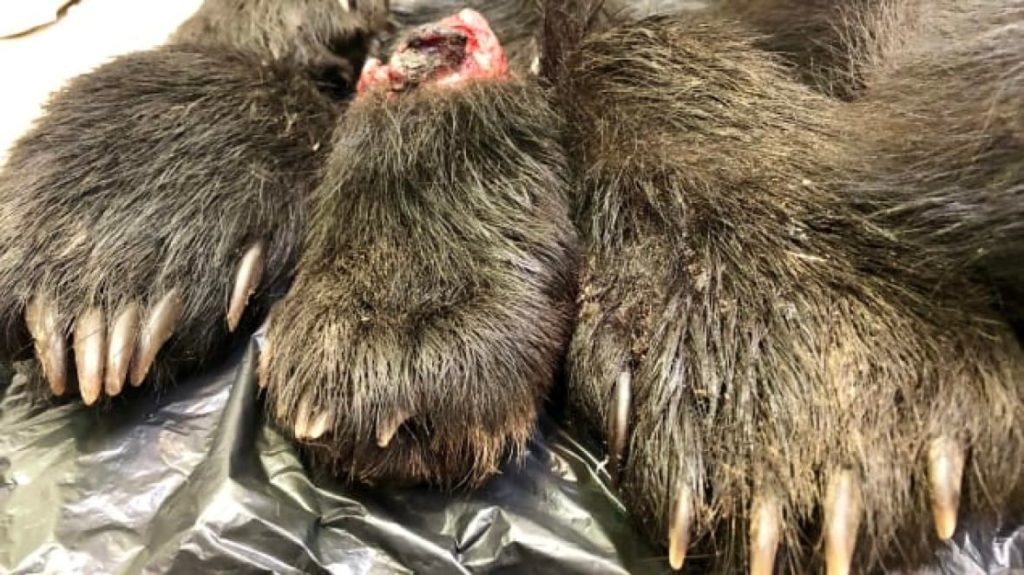
Black bear paws confiscated recently in anti-poaching investigation in Canada.
“We do not subscribe to the commercialization of wildlife because it eventually leads to an unlawful activity. The drain on wildlife resources because of all the various markets and demands for either wildlife or parts is tremendous. We would support a law banning the commercialization of black bear parts and any other law that addresses the unlawful traffic in wildlife.” J.R. Fagan, Director of the Pennsylvania Game Commission Bureau of Law Enforcement
Between 1997-2006 the Vermont Fish & Wildlife Department (VFW) said it would establish a monitoring and tagging program for the sale of all bear parts to evaluate sale levels. After VFW conducted a survey of successful bear hunters that indicated that, “bear hunters fully utilized harvested bears” VFW concluded that the sale of gallbladders was found to be insignificant and not a threat to the state’s healthy bear population. The department also said a tagging and monitoring program was not necessary.
Although the sale of gallbladders has been deemed to be insignificant, the agency however stated, “The Department will continue to monitor the sale of black bear parts. If trends and activity in the sale of bear parts, particularly gallbladders, is found to be detrimental to Vermont’s bear population or pose a threat to bear populations in other parts of the world, it may propose further regulation or prohibition of such sales.”
According to the U.S. Justice Department and Canadian news reports, the illegal trade in black bear gallbladders and other parts continues to be a problem made no easier by the legal allowance of bear part sales by a handful of states including Vermont. Such allowances create a legal conduit for the trafficking of illegally obtained bear gallbladders. Keep in mind that there is no tagging or labeling system that would differentiation between legal and illegal gallbladders or other parts. While it would be illegal to transport any bear to a state where commerce in bear parts is allowed, this is virtually impossible for law enforcement officials to prove.
Seized black bear gallbladders in Quebec.
The impossibility of distinguishing the gallbladder of a California black bear from an Idaho black bear, or any other state’s bear population enables smugglers to acquire gallbladders illegally in one state, transport them to a state where commercialization of bear parts is legal, and sell the gallbladders under false pretenses. Even wildlife enforcement officials in states which allow trade of bear parts (such as Idaho) recognize the deleterious impact such legal trade may have on other states’ law enforcement efforts and bear populations. Ray Lyon, Enforcement Assistant Chief for Special Operations in Idaho’s Fish and Game department, acknowledges that “Idaho is one of the states that still allows the sale of bear and other animal parts. We realize that there is some illegal killing of bears promoted by our laws.”
In the United States, a patchwork of state laws governing bear part sales exists. Currently, thirty-three states prohibit commercialization of bear gallbladders, while a small minority of states including Vermont, allow unfettered trade. The remainder either allow selling or buying galls if they come from bears killed in another state or have no such laws because of no black bear population.
Please join Vermont Wildlife Patrol in our current effort to prohibit the sale of black bear gallbladders in Vermont. We are asking supporters to respectfully request that Commissioner Christopher Herrick recommend to the Vermont Fish & Wildlife Board that the sale in black bear internal organs be prohibited.
Email for Vermont Fish & Wildlife Department, Commissioner Christopher Herrick:
christopher.herrick@vermont.gov
“The poaching of bears is a national problem that is destined to become worse, and I believe that we have a real opportunity, if we act now, to protect the bear populations in this country from individuals seeking to profit from the slaughter and sale of the organs of these magnificent animals.” US Senator Mitch McConnell
For More Information on the illegal black bear trade: