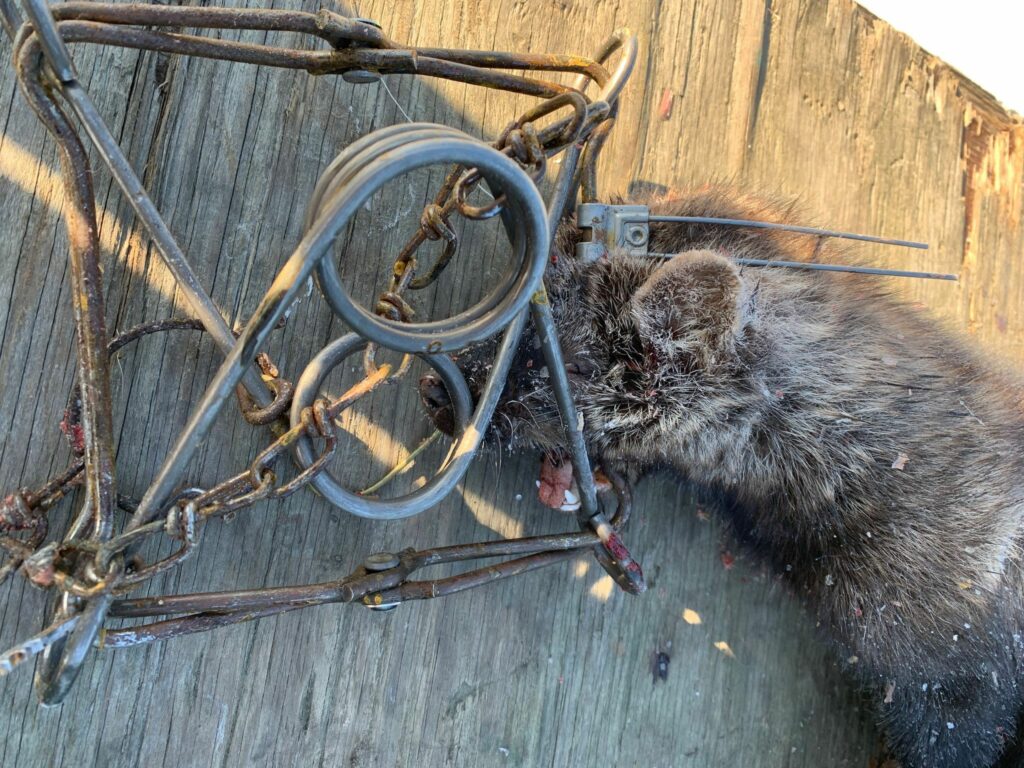

This winter, the Vermont Fish and Wildlife Board will ask state legislators to change body-gripping trapping rules to allow smaller meat-baited traps back onto a landscape that have a long-documented history of “incidental take” of endangered American marten. The American marten, sometimes called the pine marten, was extirpated in Vermont and much of New England by the 1900s due to trapping and rampant deforestation. Vermont sits at the southern edge of the marten’s range, with healthier populations in Maine and New York.
“When that rule [furbearer] did get passed, there was an error in the final ruling that we all missed. You can call it a typo, a clerical error, an administrative error. I’ll get into it in more detail another time, but it involves the use of baited body grip on land. There was an error in the size of trap that could be used in that scenario. So I’m going to get this on the agenda for next month and know we can get into it more deeply then, but it’s going to involve opening up the trapping rules to fix this error. It’s been a hardship for trappers for the last two years.”
Chairman Paul Noel, Vermont Fish and Wildlife Board, July 2026 Meeting
In 1989, Vermont launched its own marten reintroduction program in the southern Green Mountains. The reintroduction was at first considered a failure, due in part to competition from other furbearers like the fisher and gray fox, but later surveys have confirmed marten in the same southern mountain reintroduction areas. Since then, other small marten populations are believed to be slowly and naturally recolonizing areas between the Green Mountains and remote regions of the Northeast Kingdom.
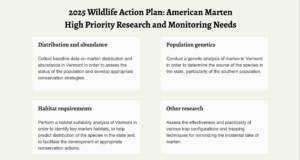
Both the 2015 and 2025 Vermont Wildlife Action Plans list the American marten as an endangered, high-priority Species of Greatest Conservation Need. Like so much other wildlife, habitat degradation and climate change continue to pose serious threats to marten recovery. Marten prefer high elevations, heavy snow and dense forest with good canopy, but as prime habitat shrinks, marten and fisher ranges overlap, giving the larger fisher an advantage over its smaller cousin.
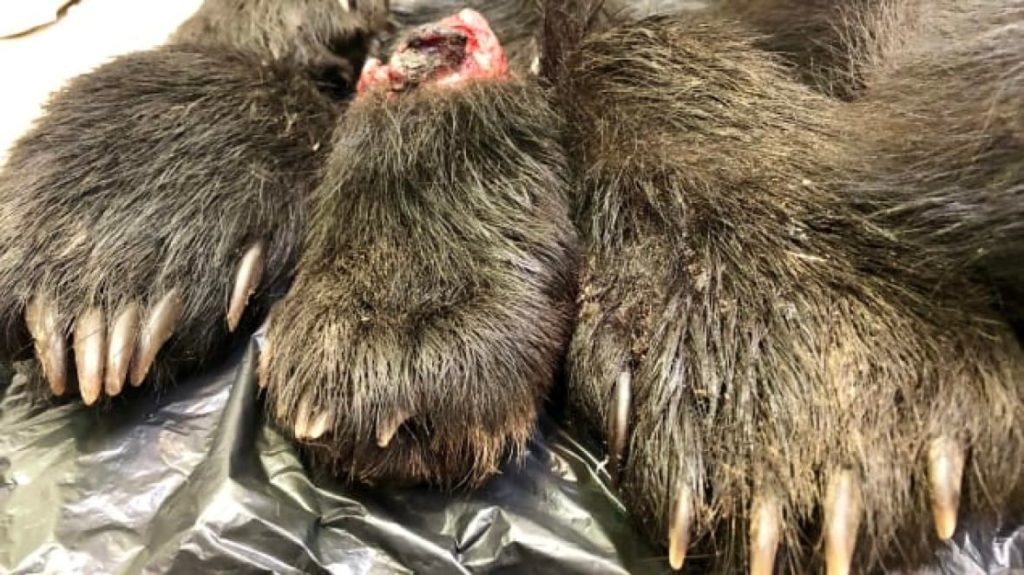
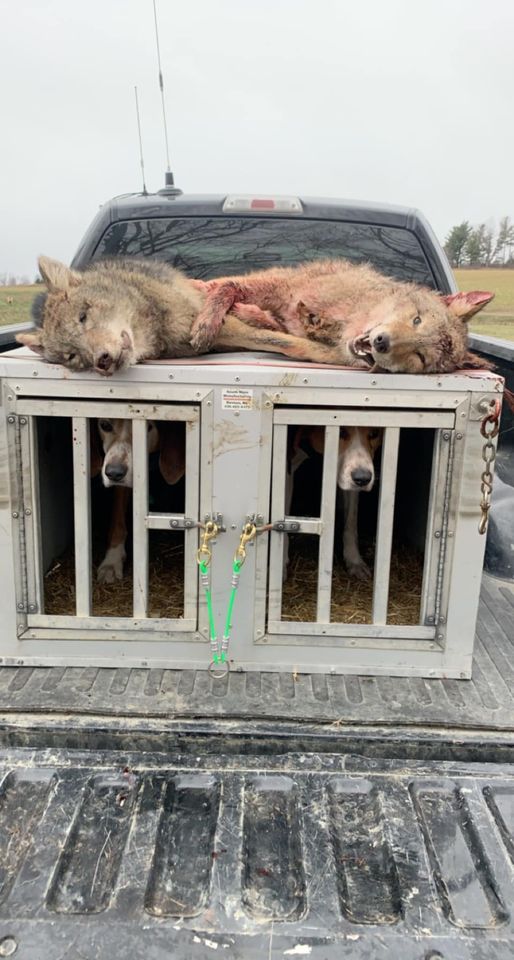
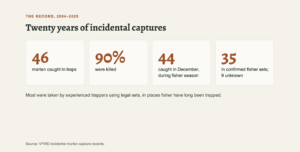
The first official “in hand” marten recorded in Vermont was in 2004, when a dispersing male was caught and killed in a trap set for fisher in Averill. It wasn’t the first marten killed in a fisher trap; back in 1990, shortly after the reintroduction, one of the released animals was killed in a fisher trap in Shrewsbury. Since 2004, at least 45 more marten have been caught in body-gripping traps, all during Vermont’s December fisher trapping season, all but two were killed. Without a doubt, fisher traps have revealed, and killed, more marten than even the Vermont Fish and Wildlife Department previously knew were here. A few have been recorded as roadkill, but since 2004, fisher trapping has remained the number one recognized threat to marten recovery in the Green Mountain State.
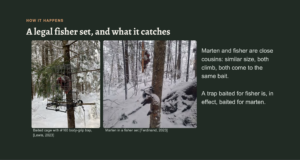
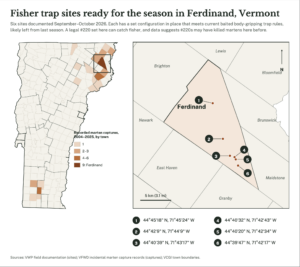
The problem is that the endangered marten living in areas with high concentrations of fisher trapping are easily attracted to the same bait and lures used in fisher sets, making any legal fisher trap in known marten habitat, also a marten trap. Yet since 2004, no special requirements have been put in place for body-gripping traps used in fisher sets, or for trappers who catch an endangered marten. There is no requirement to modify triggers to avoid marten, and no requirement to pull or move your traps once you’ve caught an endangered marten. That’s the bigger part of the problem: there have been no restrictions at all on fisher trapping in the two isolated areas where most marten continue to be caught and killed. The only requirement is for trappers to report marten captures to a warden.
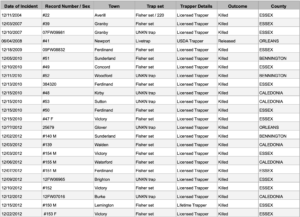
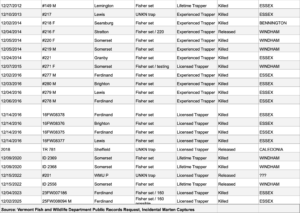
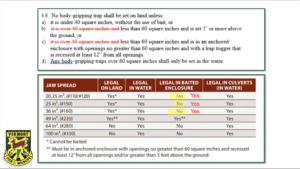
According to Vermont Fish and Wildlife public records, as many as 11 individual marten were killed by fisher trappers during the one-month trapping season in 2012. In 2016, one fisher trapper caught and killed four marten in just five days, and was legally allowed to keep trapping in the very same areas. The smaller body-gripping traps the Board now wants to allow (#110, #120, #150 and #160) are the recommended trap for catching marten in states where it is legal to trap marten. Since they were removed from legal baited sets in 2024, reported marten captures dropped. The Fish & Wildlife Board and lawmakers should keep it that way.
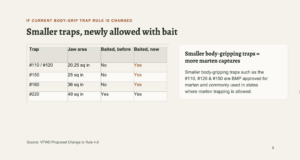
“The proposed change is a technical correction of an unintentional limitation on trap size, the correction is intended to reduce instances of incidental take.”
Hannah Smith, General Counsel, Vermont Department of Fish & Wildlife
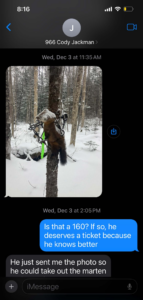
The solution need not be a call to ban trapping, instead we are appealing for trappers to voluntarily take more care in areas where Vermont’s endangered marten are still recovering. This is also an appeal to those opposed to trapping to grow more tolerant of sustainable wildlife management. That is why on October 14, 2026, Vermont Wildlife Patrol presented a petition to the Fish and Wildlife Board asking for restrictions on the use of smaller baited body-gripping traps in marten recovery areas and for protocols to be put into practice for when marten are caught in fisher traps. We are asking that such restrictions remain, until marten recovery goals outlined in the Vermont Fish and Wildlife Department’s Wildlife Action Plans are met.
No successful reintroduction of marten, fisher, or other furbearers to places they once lived in Vermont would have been possible without the support of trappers. It only makes sense that they, too, want the fullest, healthiest return of wildlife that not long ago might have been gone forever. A 2022 survey found that 91% of Vermont residents support trapping when it helps return native species to the state. The successful recovery of marten cannot happen without the support of Vermont’s trapping community.
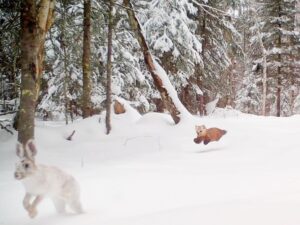
Among the things I love most about Vermont are those quiet winter mornings, staring out my dining room window at the wild world that still surrounds us. I watch black-capped chickadees, juncos and other birds visit our bird feeders. Red squirrels often feed lazily alongside them, leaving me hoping for a “circle of life” moment when one of their native predators drops down to complete the wild food chain. One of those predators is the American marten, which, like so many of Vermont’s endangered species, is struggling to make a full recovery. We can ensure the marten’s return to Vermont. But only if we are willing to work together in the best interests of all Vermonters, both human and animal.
We are asking concerned Vermonters to contact their county representative to the Fish and Wildlife Board to ask that they not allow smaller baited body-gripping traps in known endangered marten areas and to support Vermont Wildlife Patrol’s petition to restrict fisher trapping in towns where marten have already been killed.
Hannah Johnson Caledonia County: ANR.FWBoardCaledonia@vermont.gov
Richard Craig Lamoille County: ANR.FWBoardLamoille@vermont.gov
Robert Patterson Addison County: ANR.FWBoardAddison@vermont.gov
Ryan Kilborn Orange County: ANR.FWBoardOrange@vermont.gov
Neal Hogan Bennington County: ANR.FWBoardBennington@vermont.gov
Paul Noel (Chair) Orleans County: ANR.FWBoardOrleans@vermont.gov
Heather Furman Chittenden County: ANR.FWBoardChittenden@vermont.gov
Martin Van Buren Rutland County: ANR.FWBoardRutland@vermont.gov
Christopher Masson Essex County: ANR.FWBoardEssex@vermont.gov
Jon Valsangiacomo Washington County: ANR.FWBoardWashington@vermont.gov
Jeffrey Corey Franklin County: ANR.FWBoardFranklin@vermont.gov
David Deen Windham County: ANR.FWBoardWindham@vermont.gov
Beth Deimling Grand Isle County: ANR.FWBoardGrandIsle@vermont.gov
Nicholas Burnham Windsor County: ANR.FWBoardWindsor@vermont.gov
October 14, 2026 Vermont Fish and Wildlife Board Meeting: Vermont Wildlife Patrol Petition Presentation Begins @ 2:10:24
https://youtu.be/44WTKE2029k?si=NfiGlr69R0zhnVVL
Links to incidental take records for American marten in Vermont::
https://drive.google.com/file/d/16K8qC388I0dDJ_oGVKfeevccG4K-pAcr/view?usp=sharing
https://drive.google.com/file/d/1AgZltp8lv3007_niiUQmiP7j2Aq5goJu/view?usp=sharing
https://drive.google.com/file/d/1Oy3Q6Qkt7W7r2ly68tA2Z0jwJn9oaLov/view?usp=sharing
https://drive.google.com/file/d/15a_4nUgmPxfY1z2Hn0AA1LwPOobKWDYE/view?usp=sharing
https://drive.google.com/file/d/1uyKVIbbcwVR0ra2igiRWaXML7LkDDPiv/view?usp=sharing
https://drive.google.com/file/d/1eanUdDphkMaoShNs6TZj12ylFY9Tet14/view?usp=sharing
https://drive.google.com/file/d/1ntv2O1dJXnV6HOHxNs9Rbjq9Z7MGC7C7/view?usp=sharing
https://drive.google.com/file/d/1YPZAxQQSgo_FboAMgFoaP_ohTEbrPOLV/view?usp=sharing
https://drive.google.com/file/d/1qt6XkJI5QYTWS-qO0EFXZJeHFn7u4YEu/view?usp=sharing